Every Holiday with Evelyn Guide

Paint Pens

Paint pens are useful for small details, outlines, trim and touch-ups. The key is choosing the right type and tip size, testing it first and knowing when a brush will give you a better result.

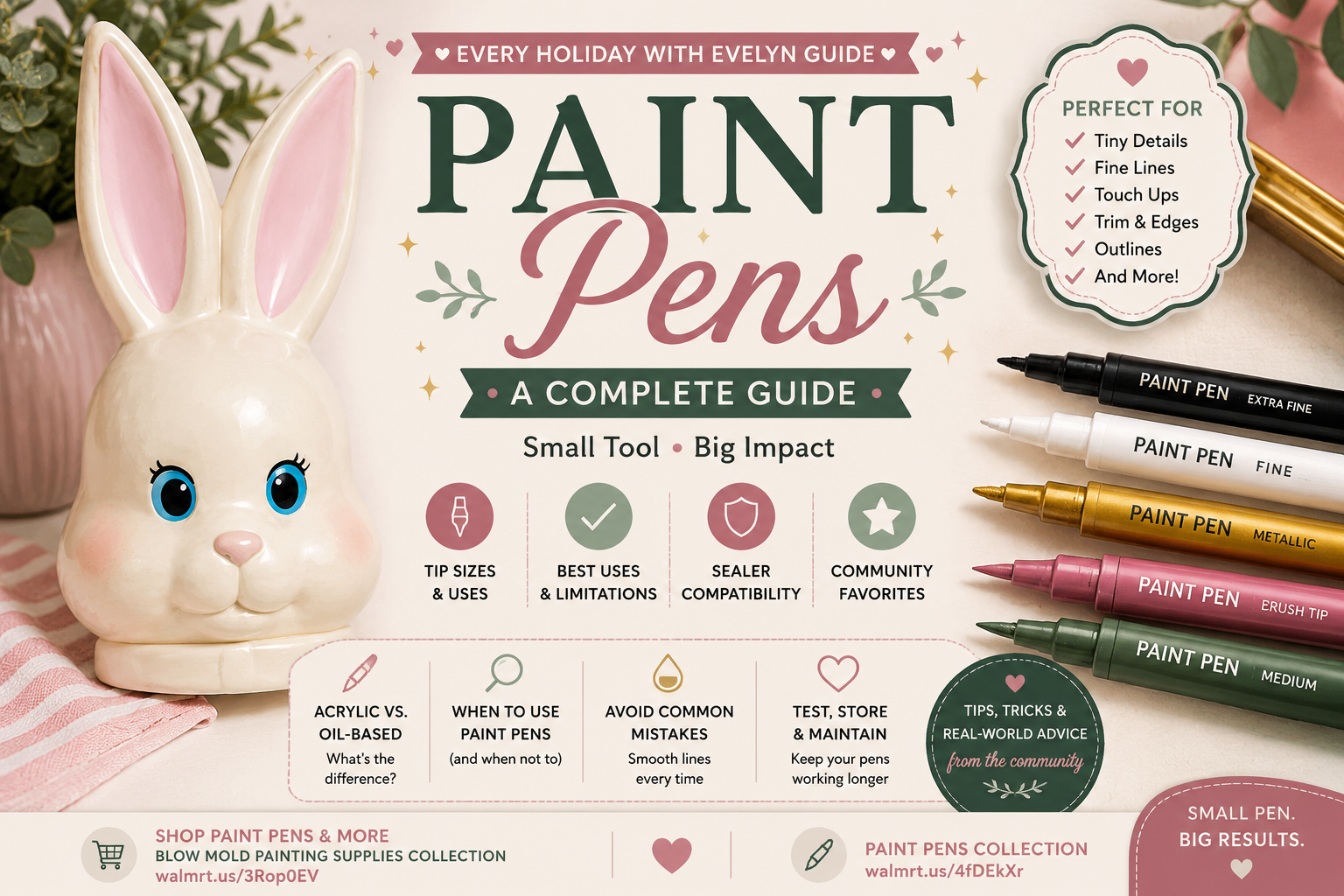
Painted Easter bunny blow mold beside black, white, metallic and colored paint pens with a complete paint pen guide title.
At a glance

What paint pens are good for

✍️

Fine details

Useful for pupils, catchlights, small outlines, lettering and narrow molded details.

Metallic accents

Helpful for small gold or silver details when a brush feels difficult to control.

🖌️

Touch-ups

Good for correcting small gaps or edges after the main painted area has fully dried.

↔️

Clean lines

Paint pens can help with short lines and trim, especially on smooth areas with clearly molded guides.

Evelyn’s Tip Always test the pen on scrap material or a hidden area first. Check the color, paint flow and finish before using it on the front of the project.
Choose the formula carefully

Acrylic vs. oil-based paint markers

Acrylic paint pens

Acrylic paint pens are often water-based and are commonly used over acrylic-painted craft projects. They are usually easier to clean up while wet and may have less odor.

Check the exact label for approved surfaces, curing instructions and indoor or outdoor use.

Oil-based paint markers

Oil-based markers can create durable, opaque marks on some surfaces, but they may have stronger odor and different compatibility and cleanup requirements.

Do not assume they will work with every primer, acrylic paint or sealer. Test the full combination first.

“Permanent” does not automatically mean weatherproof, UV-resistant or safe for permanent outdoor display. Follow the exact product label.
Tip sizes

Choose the size for the detail

Extra-fine tips

Best for very small lines, pupils, tiny catchlights and fine lettering. They can clog more easily and may feel scratchy on heavily textured surfaces.

Fine tips

A useful general choice for outlines, facial details and narrow trim. Fine tips offer control without being as delicate as the smallest tips.

Medium tips

Helpful for wider lines, filling small molded areas and creating bold details. They may be too large for tiny facial features.

Brush tips

Brush tips can create thick and thin strokes depending on pressure. They are useful for lettering and decorative marks but require a steadier hand.

The printed tip size does not always tell you exactly how wide the finished line will be. Paint flow, pressure, surface texture and the angle of the pen can all change the result.
Step by step

How to use a paint pen

1

Read the label

Check whether the pen should be shaken, how the tip is primed, which surfaces it is made for and how long the paint should dry or cure.

2

Shake it with the cap on

Shake only as directed by the manufacturer. Keep the cap secured so paint does not spray or leak.

3

Prime it away from the project

Press the tip on scrap paper or another approved test surface until the paint begins to flow. Do not pump the tip directly on the blow mold.

4

Remove excess paint

Test a few short strokes before moving to the project. The tip should be coated but not dripping.

5

Use light pressure

Let the paint flow from the tip. Pressing too hard can flatten the tip, release too much paint or scratch a soft painted surface.

6

Let it dry fully

Follow the pen’s drying and curing instructions before adding another color, handling the area or applying a topcoat.

Evelyn’s Tip Keep scrap paper beside you while working. Test the flow again whenever the pen has been sitting for a few minutes.
Use the right tool

When paint pens work well

  • Small facial details and catchlights
  • Short outlines and molded edges
  • Lettering and decorative marks
  • Tiny metallic accents
  • Small corrections after the base paint dries
  • Dot details and simple patterns

When a brush may be better

  • Large areas that need smooth coverage
  • Long lines where a pen may skip or drag
  • Deeply textured surfaces
  • Blended, shaded or dry-brushed effects
  • Areas where you need to mix a custom color
  • Projects where the pen formula is not compatible with the paint system
Paint pens are a helpful tool, not a replacement for every brush. Many projects look best when both are used.
Color choices

White, black, metallic and colored pens

White

Useful for catchlights, teeth, snow accents and small corrections. Bright white may look bold, so compare it with the surrounding paint.

Black

Helpful for pupils, outlines, lettering and small facial details. Test the flow carefully because black paint can be difficult to hide if it floods.

Metallic

Useful for gold and silver trim, buttons and highlights. Metallic pens may need more than one light pass for even coverage.

Colored sets

Convenient for small accents, irises and decorative details. A large set is optional if you already own matching acrylic paints and brushes.

Common problems

Fixing paint pen mistakes

The pen released a blob. Stop and let the area dry. Cover or reduce the mark with the surrounding color instead of wiping wet paint across the surface.
The line is too thick. Let it dry, then use a small brush and the neighboring color to narrow the line.
The line looks uneven. Apply a second light pass only after the first one has dried. Avoid repeatedly dragging the pen through wet paint.
The tip keeps skipping. Test and reprime the pen on scrap material. The surface may also be too textured for that tip size.
The paint scratches off. Stop using the pen and review surface preparation and product compatibility. The base paint may not be cured or the pen may not be suitable for the surface.
The metallic color looks streaky. Let it dry and apply another thin pass in the same direction. Avoid overworking metallic paint while it is tacky.
The tip feels dry. Follow the manufacturer’s directions for repriming or cleaning the tip. Do not add water or solvent unless the label specifically allows it.
The sealer changed the finish. Stop and test the same combination on scrap material. Some topcoats may change shine, soften marks or react with certain marker formulas.
Keep them working

Storage and maintenance

  • Replace the cap firmly after every use.
  • Store the pen in the position recommended on its label.
  • Keep paint from drying around the cap and tip.
  • Do not leave pens in extreme heat or cold.
  • Test the flow before each painting session.
  • Keep oil-based and acrylic pens clearly separated.
Storage directions vary. Some paint pens are meant to be stored horizontally while others may have different instructions. Follow the exact product label rather than using one rule for every brand.
Community favorite uses

Where painters often reach for paint pens

These are common community uses, not requirements. The best tool depends on the surface, project size and finish you want.

Eyes and faces

Pupils, catchlights, lashes, small outlines and tiny facial corrections.

Gold trim

Narrow molded borders, buttons, stars and small metallic accents.

Patterns

Dots, simple stripes, snowflakes and small repeated decorative marks.

Final touch-ups

Filling small gaps and correcting edges after the main painting is complete.

Helpful supplies

Paint pens and painting tools

Browse the paint pen collection

This collection includes paint pens for details, outlines, metallic accents and other small painting jobs. Check each listing for tip size, formula and approved surfaces.

Shop Paint Pens

Browse all blow mold painting supplies

Find brushes, tape, paints, skin tones, paint pens and other supplies for blow molds, nutcrackers and molded holiday décor.

Shop the Full Supply Collection
For outdoor projects, confirm whether the exact paint pen is approved for outdoor exposure. Test the primer, base paint, pen and sealer together before using the combination on the full project.

This section contains affiliate links. Every Holiday with Evelyn may earn a commission from qualifying purchases at no additional cost to you.

Frequently asked questions

Paint pens FAQ

Can I use paint pens over acrylic paint?

Often, but the acrylic paint must be properly cured and the formulas must be compatible. Test the exact paint pen over the exact base paint before using it on the main project.

Are paint pens safe for outdoor blow molds?

Only if the exact product label supports the surface and intended exposure. “Permanent” and “multi-surface” do not automatically mean long-term outdoor safe.

Which tip size should a beginner buy?

A fine or medium tip is often easier to control for general detail work. Extra-fine tips are useful for very small marks but can be more delicate and may skip on texture.

Why did my paint pen suddenly release too much paint?

The tip may have been pumped too many times or pressed too firmly. Prime and test the pen away from the project, then use light pressure.

Do I need to seal paint pen details?

That depends on the pen, base paint, project surface and display location. Use only a compatible topcoat and test it first because some sealers can change the appearance of paint-marker details.

Can I use an oil-based marker over acrylic paint?

Possibly, but compatibility varies. Let the acrylic paint cure fully, read both product labels and test the combination before using it on the project.

How do I remove a paint pen mistake?

Avoid immediately reaching for a strong cleaner because it may damage the base paint or plastic. Let the mark dry and cover it with the surrounding paint color whenever possible.

Why does the pen scratch my painted surface?

The base paint may not be fully cured, the tip may be too hard for the surface or you may be pressing too firmly. Stop, test on scrap material and use a softer touch or a brush instead.

Need more painting help?

Find more tips and community support

Visit the Every Holiday with Evelyn communities for project inspiration, or browse the FAQ library for more painting and decorating answers.