
Every Holiday with Evelyn Guide
Paint Brush Guide
You do not need dozens of brushes to paint a blow mold. Here are the brushes I use for large sections, trim, faces and small details.
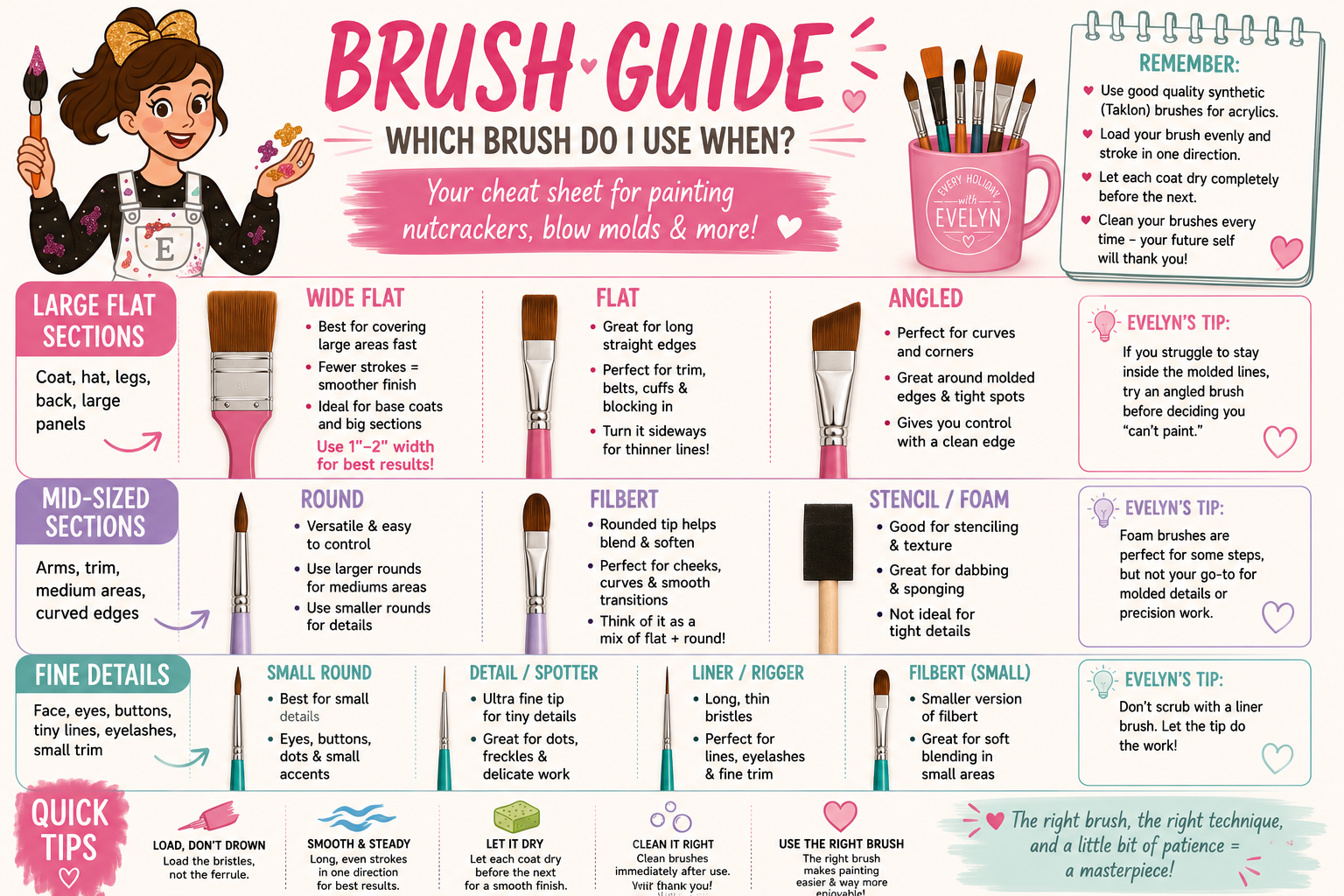
Which Brush Should I Use?
Match the brush to the size and shape of the area you are painting.
Start Here
I recommend synthetic or Taklon brushes for acrylic paint.
They are easy to find, easy to clean and available in all the shapes you need for painting blow molds.
The Brushes I Use Most
If you are building a basic brush collection, these are the shapes I would start with.
Wide Flat Brush
I use it for coats, hats, legs, backs and other large sections.
A 1 to 2 inch synthetic brush covers more space with fewer strokes, which helps large areas look more even.
Flat Brush
I use it for belts, cuffs, straight trim and medium sections.
The straight edge makes it easier to follow molded lines. Turn it sideways when you need a thinner stroke.
Angled Brush
I use it for curved trim, collars, cuffs and raised edges.
The pointed edge gives you more control around curves and tight corners.
Round Brush
I use it for faces, buttons, small sections and controlled details.
A larger round works well for medium areas. A smaller round is better for eyes and other details.
Detail and Liner Brushes
I use them for eyelashes, thin outlines, mouths and tiny trim.
Use a small detail round for dots and tiny marks. Use a liner brush for longer, thin lines.
Tips for a Smoother Finish
If your paint looks streaky, the brush or technique may be the problem.
Use a Brush That Fits the Area
A small brush creates more overlapping strokes on large sections. Use a wider brush for coats, hats and legs.
Do Not Overload the Brush
Load the bristles without pushing paint into the metal ferrule. Wipe off any obvious excess before painting.
Use Light Pressure
The bristles should bend slightly, not flatten against the surface. Heavy pressure leaves stronger brush marks.
Do Not Overwork Drying Paint
Work in small sections and stop brushing once the paint begins to set. Let each coat dry before adding another.
Build Coverage with Thin Coats
Do not try to get perfect coverage in one coat. Several thin coats usually look smoother than one heavy coat.
What I Would Buy First
Start with one variety set and one large flat brush. That is enough for most blow mold projects.
Royal & Langnickel 25pc Taklon Set
A mixed set with several useful shapes and sizes for trim, faces and detail work.
Shop the 25pc Taklon SetGroup Member Favorite Brush Set
This set is used and recommended by many members of our nutcracker and blow mold communities.
Shop the Community FavoriteArtist's Loft 2" Wide Synthetic Brush
This is the large brush I would add to any basic set. It is useful for coats, hats, backs and other wide areas.
Shop the 2" Wide Brush#affiliatelinks · I may earn a commission from qualifying purchases at no additional cost to you. Community feedback is noted where applicable, and I have not personally tested every set listed.
How to Clean Your Brushes
Acrylic paint dries quickly, so clean your brushes as soon as you finish using them.
Remove Extra Paint
Wipe away as much paint as you can before rinsing.
Wash the Bristles
Use water and mild soap or brush cleaner until the water runs clear.
Reshape the Brush
Gently smooth the bristles back into their original shape.
Let It Dry Flat
Do not leave brushes standing in water or store them with the bristles facing down.
Can You Save a Dried Brush?
The Masters Brush Cleaner & Preserver can help clean and condition brushes that need more than a quick rinse. It works best when you clean dried paint as soon as you notice it.
Shop The Masters Brush CleanerNeed Help with Your Project?
Join one of our nutcracker and blow mold communities to ask questions, share your progress and see what other members are painting.